
Decatur County Court Records After Arrest
The local starting point is the warning on the Decatur County Sheriff's Office inmate-bookings page: charges shown on the jail roster are not final until prosecutors and courts review them. That one notice explains why court records after a jail arrest must be checked through court channels, not just through the roster. A person may be arrested by the sheriff, Bainbridge Public Safety, Georgia State Patrol, GBI, or another agency, then booked into Decatur County Jail. From there, the case can move through first appearance, bond review, prosecutor screening, filing, hearing dates, and disposition.
The South Georgia Judicial Circuit District Attorney handles prosecution context for Decatur County state cases. The clerk and courts maintain the case record after charges are filed. For jail custody, booking date, and current confinement, use Decatur County jail inmate records. For booking-photo issues, use Decatur County jail mugshots. Those records may overlap with the court case, but they are not the same source. Court records after an arrest track the legal case and charge status.
The Decatur County Clerk of Court page identifies Clerk Cecilia Willis at the Historic Decatur County Courthouse.
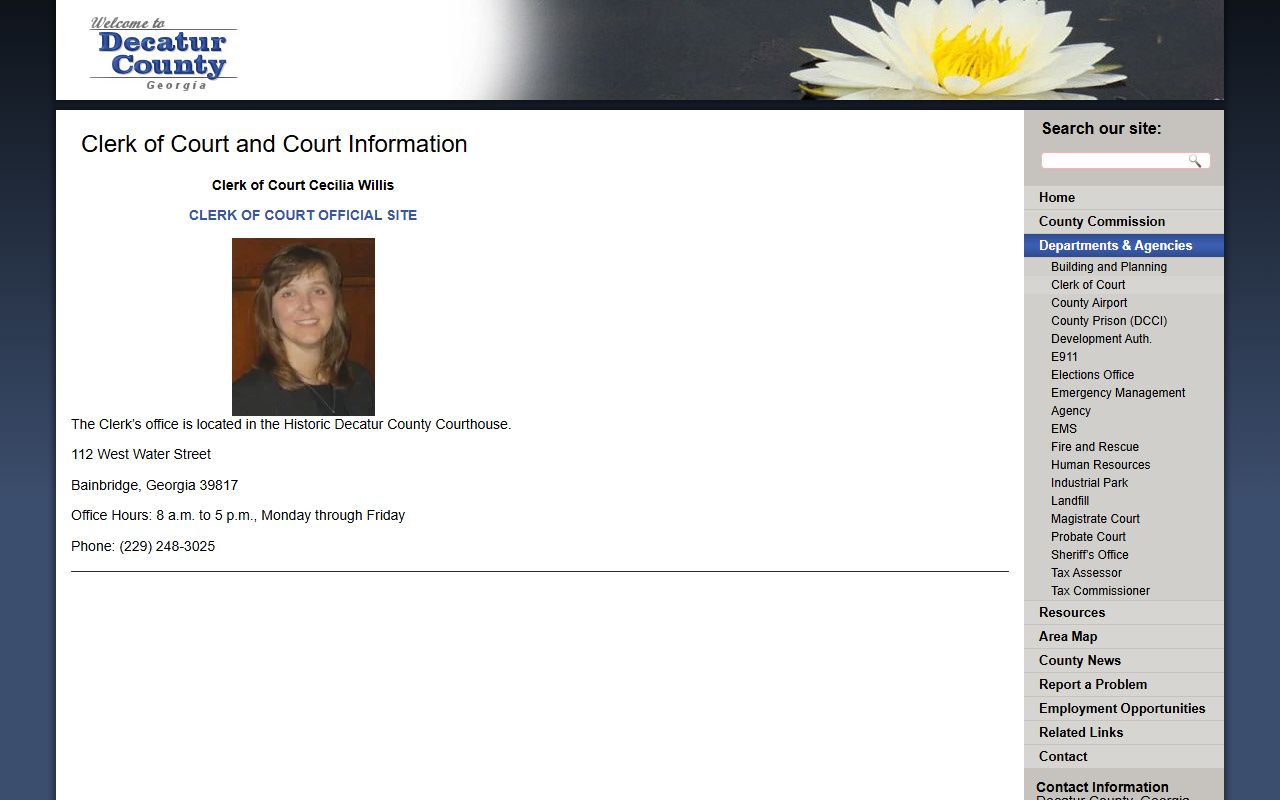
The clerk page is useful when an e-access search does not show an expected case, an older record must be checked, or a sealed or restricted matter needs official handling.
Find Decatur County Court Records
Decatur County Superior and State Court records are listed through Georgia Courts e-access. That state page lists Decatur State and Decatur Superior and says users are redirected to provider websites. It also says an account is required. Magistrate Court uses separate local information. The Magistrate Court site says case status may be checked by contacting the clerk's office or by searching through the court's case lookup system, but the source material did not document the exact public lookup URL.
The best search fields depend on where the case has reached in the process. A name search can work soon after filing. A case number is stronger if it appears on bond paperwork, a citation, a court notice, or a clerk response. A date range may help when several people share a name. If the case does not appear, it may not be filed yet, it may be in a different court, or the record may be restricted from public access.
| Search Field | Type | Required | Decatur County Notes |
|---|---|---|---|
| Georgia Courts e-access court link | Provider link | Account required | Decatur State and Decatur Superior are listed separately. |
| Account login | Login | Yes for e-access | Georgia Courts says users must have an account before searching provider records. |
| Defendant or party name | Search field | Provider-specific | Use the full legal name from jail, bond, or court paperwork when known. |
| Case number | Search field | Provider-specific | Use if it appears on a citation, bond document, court notice, or clerk response. |
| Court | Court selection | Yes | Choose Decatur Superior, Decatur State, or the separate Magistrate route as appropriate. |
| Filing date or date range | Date | Not confirmed | The exact provider form and fee schedule were not captured. |
The Georgia Courts e-access page is the statewide entry point documented for Decatur State and Superior court records.
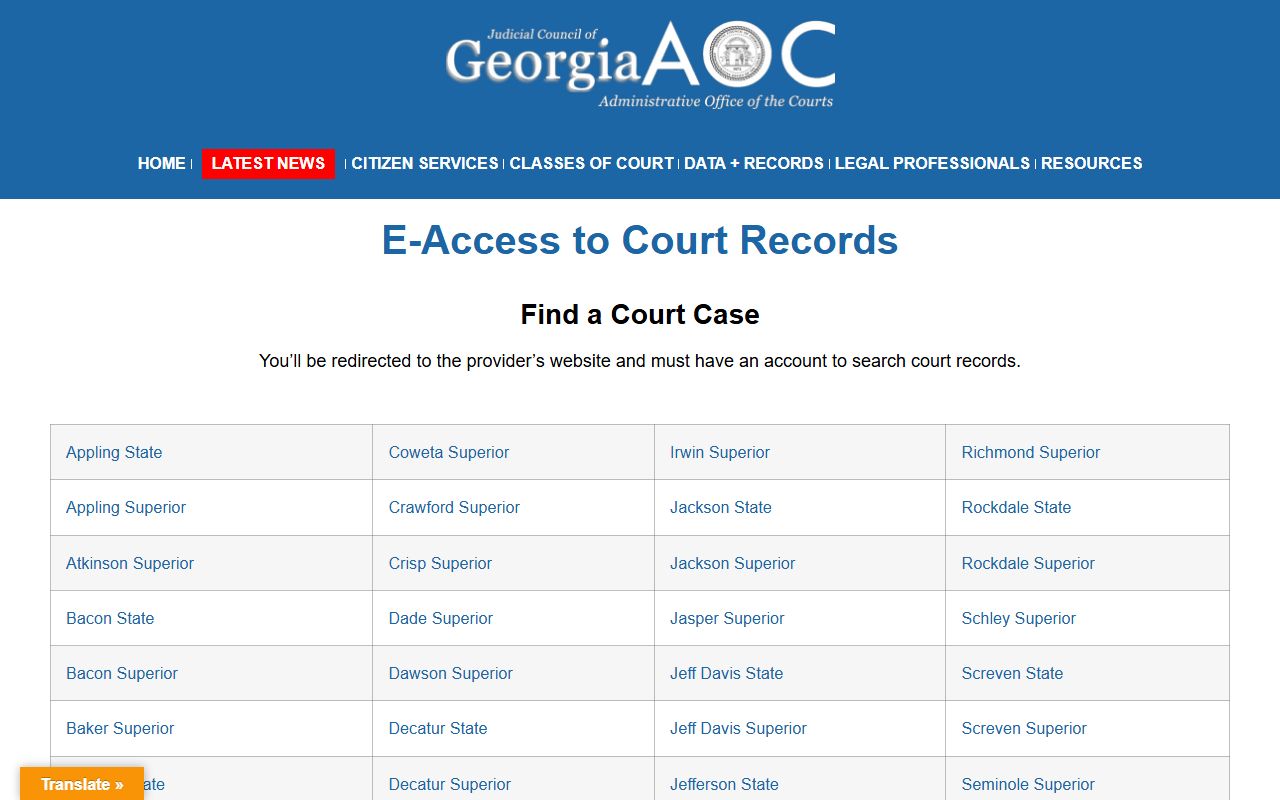
Because e-access redirects to provider sites, the clerk remains the official fallback when the provider search is unavailable or inconclusive.
Decatur County Arrest Charge Papers
After a jail arrest, the charge listed at booking may be only the first label used by law enforcement. The formal court record begins when a charging document is filed or when the case is otherwise docketed. The District Attorney may file a prosecutor charging paper, amend the charge, decline to continue a charge, or present felony matters to a grand jury. Magistrate Court may also be involved with warrants, summons, minor criminal matters, and bond hearings at the judge's discretion.
| Document | Who Uses It | What It Means After Arrest | Where to Verify |
|---|---|---|---|
| Complaint | Officer, prosecutor, or court process | Starts or supports a criminal case based on alleged facts. | Magistrate, State, or Superior records, depending on the case. |
| Accusation or information | Prosecutor | Formal prosecutor-filed charge, often used without indictment where allowed. | Clerk of Court or e-access provider record. |
| Indictment | Grand jury | Formal felony charging document after grand-jury action. | Superior Court record and clerk file. |
The South Georgia Judicial Circuit District Attorney's prosecution role page explains that the DA represents the State, prosecutes criminal offenses, directs further criminal investigations, recommends sentencing, and oversees grand jury proceedings. That is why a Decatur County booking charge may differ from the filed court charge.
Decatur County Charge Status
Charge status can change more than once after arrest. A court record may show a pending count, a count amended to a different offense, a reduced charge, a dismissal, or a nolle prosequi entry. Nolle prosequi means the prosecutor declines to continue that charge. Dismissed means the court charge ended without a conviction on that charge. Neither term should be read from the jail roster alone. The roster is a custody and booking source, while the court docket is the case source.
| Status | Plain Meaning | Why It Matters |
|---|---|---|
| Pending | The charge is active and unresolved. | The case may still have hearings, plea dates, trial dates, or bond conditions. |
| Amended | The filed charge changed after review. | The final filed charge may not match the first booking entry. |
| Reduced | The charge moved to a lesser offense. | Disposition and sentence exposure may differ from the arrest charge. |
| Dismissed | The charge ended by court order or prosecution action. | A dismissal is not the same as a conviction. |
| Nolle prosequi | The prosecutor will not continue that charge. | The case record should be checked for any remaining counts. |
| Conviction | A guilty plea, verdict, or finding resulted in guilt. | This is the result many background checks look for, but it differs from an arrest. |
For victim-services or prosecution questions, the court-officers page lists District Attorney Joseph Mulholland and a victim-services phone. For family members checking whether the person is still in custody, VINELink or the jail may be more direct than the court docket.
Bond After Decatur County Arrest
Bond is a promise, backed by money, property, a surety, or court conditions, that the arrested person will appear in court. Decatur County Jail says a criminal bond is not a fine. Missing court can lead to forfeiture and may cause a judge to issue a bench warrant. The jail says the State of Georgia charges a $20.00 fee for every bond written by the jail, and a debit or credit card payment for that fee carries a 3.5% convenience charge.
The jail page documents cash bond, professional bondsman, and property bond. Cash bonds may be posted by money order or cashier's check unless otherwise directed. A professional bondsman charges a nonrefundable fee, and the sheriff will not recommend one company over another. A property bond must involve qualifying Decatur County property, ownership records, signatures from all owners of record, and approval by the sheriff or designee.
Bond scam warning: Do not pay bail or bond by telephone. Confirm bail or bond information directly with Decatur County Jail at 229-248-3050.
- Cash bond
- Money or cash-equivalent bond posted for release, with written instructions needed if the surety does not want funds applied to court fines.
- Professional bondsman
- A private bondsman posts bond for a nonrefundable fee. The jail keeps an acceptable bondsmen list in the booking lobby.
- Property bond
- Qualified Decatur County real property may secure release if the required ownership documents and approvals are complete.
- No-bond hold
- A court order, detainer, or agency hold may keep a person in custody even when local bond would otherwise be available.
Decatur County Warrants and Arrest
Official source material did not identify a Decatur County sheriff active-warrant search. That does not mean a warrant does not exist. It means the public path is not a simple sheriff warrant database. The Decatur County Magistrate Court identifies warrants and summons as part of the court's work and lists Magistrate contact through local sources at 229-248-3014. The Clerk of Court can be used for bench-warrant or case-related warrant history in State or Superior matters.
A warrant can lead to a jail arrest and a current booking entry. An arrest warrant authorizes arrest based on alleged criminal conduct. A bench warrant is issued by a judge, often after failure to appear or violation of a court order. A search warrant authorizes a search and is not usually the same as a public "do I have a warrant" lookup. If a warrant arrest results in booking at Decatur County Jail, the person may show on the current booking search. If no booking appears, the person may be in another county, released, held under GDC, in federal custody, or not yet booked.
The Decatur Magistrate Court homepage documents the court's role in warrants, summons, case status, and bond hearings.

For time-sensitive warrant or bond questions, use the court or jail phone numbers from official sources rather than unofficial warrant-search sites.
Charges Versus Convictions
A Decatur County arrest charge is an accusation or booking label. A conviction is a result after a plea, verdict, or finding of guilt. This distinction matters for court records after a jail arrest because an early roster entry can be amended, reduced, dismissed, or replaced by a different court filing. A person may also be arrested and released without a final conviction on the charge that appeared at booking.
| Record Type | Charge | Conviction |
|---|---|---|
| Stage | Allegation after arrest or prosecutor filing. | Final guilt result through plea, verdict, or finding. |
| Where it appears | Jail roster, complaint, accusation, information, indictment, or docket. | Court disposition, sentencing record, and some criminal-history records. |
| Proof level | Based on probable cause or formal accusation. | Requires plea or proof sufficient for conviction. |
| Reader caution | Not proof of guilt. | Still verify the exact count, date, and court before relying on it. |
Restricted Decatur County Arrest Records
Georgia uses access limits and record restriction concepts rather than a simple rule that every arrest disappears from public view. The Open Records Act governs public inspection of government records, while exemptions can allow records to be withheld or redacted. The sheriff's mugshot notice cites O.C.G.A. 50-18-72 for image nonavailability. The Georgia Department of Corrections also says it does not publish records for offenders convicted and completed under Georgia's First Offender Act.
Sealed, restricted, and expunged are often used as if they mean the same thing. They do not. In Georgia public-facing language, "restricted" is the more common practical term for limits on public access to certain criminal-history information. A sealed court record may be hidden from ordinary public inspection. Expungement, where applicable in other contexts, is often understood as removal or destruction, but Georgia court and criminal-history access should be checked against the specific statute, agency, and order involved.
| Access Result | Sealed or Restricted Record | Expunged Record |
|---|---|---|
| Public visibility | Hidden from ordinary public access or limited by law or order. | Generally treated as removed from public record where the law allows it. |
| Agency access | Some law-enforcement, court, or authorized agency access may remain. | Access depends on the exact statute and order. |
| Best Decatur County contact | Clerk of Court for case records, sheriff open-records channel for jail records. | Ask the originating court or agency what relief applies. |
| Common mistake | Assuming a missing online record means no case exists. | Assuming every dismissal automatically deletes all records. |
Statewide criminal-history checks are a separate channel through the Georgia Bureau of Investigation criminal-history record check service. A GBI record check is not the same as a jail roster, court docket, BOP locator, ICE locator, or VINELink notification search.
Court Records and Custody Systems
Court records after an arrest do not always show where a person is housed. Decatur County Jail is the local pretrial and booking facility. Decatur County Correctional Institution and Bainbridge Substance Abuse Center are state-custody or GDC-supervised facilities, so the Georgia Department of Corrections offender search is the better route for sentenced state prisoners and GDC residents. Federal sentenced prisoners use the BOP inmate locator. ICE detainees use the ICE Online Detainee Locator System. A court case may explain why a person was arrested, while the custody system explains where that person is held.
Victims and witnesses may also use VINELink for custody status and release notification when agency participation supports it. The South Georgia Judicial Circuit court-officers page lists DA Joseph Mulholland at 114 South Broad Street in Bainbridge, the main DA office at 229-246-1823, and victim services at 229-246-5222. That prosecution channel is distinct from the jail, GDC, BOP, and ICE search channels.
Note: Always verify court results with the clerk or court record, especially when a jail booking charge and a filed charge do not match.